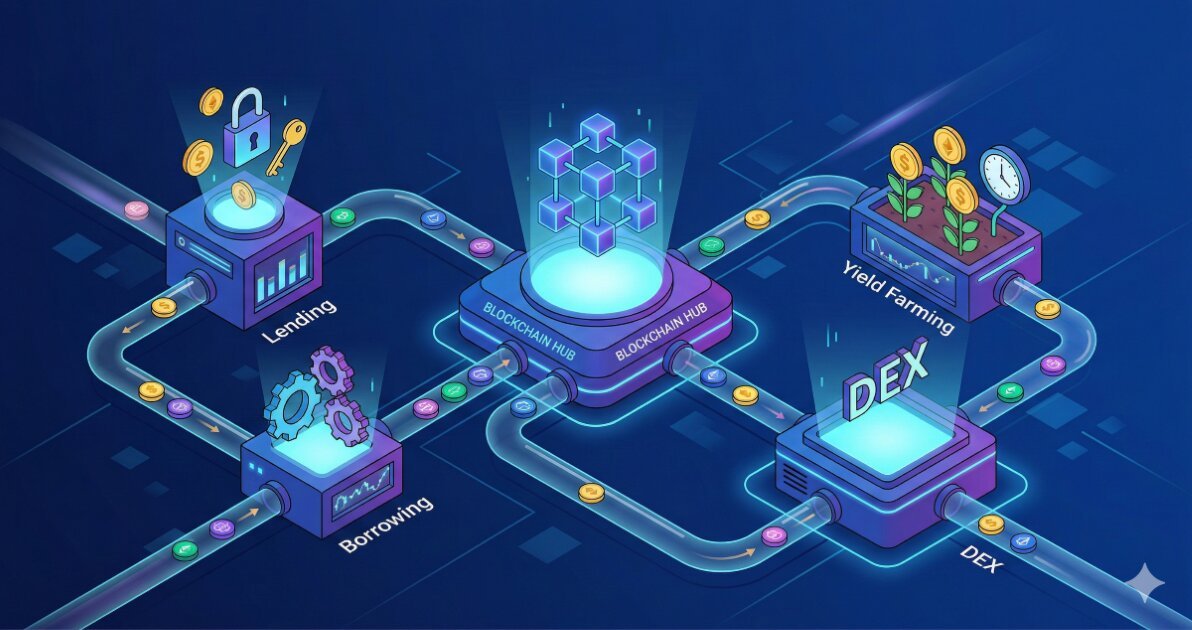
Crypto exchange websites serve as the primary interface between users and matching engines, order books, and settlement infrastructure. For developers integrating exchange APIs, traders building automation tooling, or operators evaluating platforms, understanding the technical layers beneath the UI matters. This article examines request routing, authentication patterns, rate limiting models, state synchronization challenges, and the failure modes that separate robust platforms from brittle ones.
Request Flow and State Synchronization
Modern exchange websites typically separate read and write paths. Public market data requests (ticker feeds, order book snapshots, recent trades) route through caching layers or read replicas to reduce load on primary databases. Write operations like order placement, cancellation, or withdrawal requests hit authenticated endpoints that verify balances, apply business logic, and commit state changes atomically.
The synchronization challenge surfaces when the UI displays stale or inconsistent state. A user places a market order; the website shows the order as “submitted” while the matching engine has already filled it. The UI polls a REST endpoint every few seconds, but WebSocket channels broadcast fills in near real time. Practitioners need to understand whether the exchange provides WebSocket feeds for private account events (fills, balance updates, order status changes) or relies solely on polling. High frequency strategies and arbitrage bots require WebSocket subscriptions to avoid race conditions where the UI shows outdated positions.
Some exchanges expose separate domains or subdomains for API traffic versus browser traffic. This separation allows independent scaling, rate limiting policies, and DDoS mitigation strategies. Confirm whether API keys generated through the web interface carry the same rate limits as browser session tokens or operate under different quotas.
Authentication and Session Management
Exchanges implement tiered authentication schemes. Browser sessions use cookie based tokens with CSRF protections. API integrations use HMAC signed requests or API key and secret pairs. The website generates API keys with granular permissions: read only access, trade execution without withdrawal rights, or full account control.
HMAC request signing requires concatenating request parameters (timestamp, endpoint path, body) with a secret, hashing the result, and attaching the signature to the request header. The server recomputes the hash and compares. This prevents replay attacks when combined with short timestamp windows (typically 5 to 30 seconds). If the server timestamp diverges from the client by more than the allowed window, requests fail. Practitioners synchronizing NTP on API client machines avoid this failure mode.
IP whitelisting adds another layer. The website allows users to restrict API key usage to specific IP ranges. This protects against credential theft but complicates deployments where trading infrastructure runs on dynamic cloud IPs or routes through NAT gateways. Some platforms offer temporary IP exemptions for testing or require manual re-whitelisting after infrastructure changes.
Rate Limiting and Request Quotas
Exchanges enforce rate limits at multiple granularities: per IP, per API key, per endpoint, and per order type. A typical policy might allow 1,200 requests per minute per API key for public endpoints, 600 per minute for authenticated reads, and 100 per minute for order placements. Burst allowances let clients exceed the base rate briefly before throttling kicks in.
Rate limit headers in HTTP responses indicate remaining quota, reset time, and retry intervals. The website may return a 429 status code with a Retry-After header specifying seconds to wait. Well designed clients parse these headers and implement exponential backoff rather than retrying immediately.
Order rate limits differ from general API limits. Some exchanges count each order placement, modification, and cancellation individually. Others apply weighted scoring where market orders consume more quota than limit orders, or large size orders consume more than small ones. Hidden or iceberg orders may carry higher rate costs because they interact with the matching engine differently. Verify the specific weighting formula in the API documentation; assumptions from one exchange do not transfer to another.
WebSocket connections face their own limits. Exchanges cap the number of simultaneous subscriptions per connection or per account. Subscribing to order book depth updates for 50 trading pairs on a single WebSocket may exceed the allowed channel count, forcing the client to open multiple connections or prioritize subscriptions.
Worked Example: Order Placement via REST API
A market maker wants to place a limit buy order for 1.5 BTC at 42,000 USDT on an exchange website via API. The process unfolds as follows:
- The client constructs a POST request to
/api/v3/orderwith parameters:symbol=BTCUSDT,side=BUY,type=LIMIT,quantity=1.5,price=42000,timestamp=1704067200000. - The client concatenates these parameters in alphabetical order, appends the API secret, computes the SHA-256 HMAC, and includes the signature in the
X-Signatureheader. - The exchange server receives the request, validates the timestamp (within 30 seconds of server time), recomputes the HMAC, and verifies the signature matches.
- The server checks the account balance: does the user have at least 63,000 USDT (1.5 BTC × 42,000) plus any required margin or fee reserve?
- The order passes validation and enters the matching engine queue. The server responds with HTTP 201 and a JSON payload containing
orderId=987654321,status=NEW,transactTime=1704067200123. - The client subscribes to a WebSocket channel filtering events for
orderId=987654321. When the order fills, the WebSocket message arrives within milliseconds. The REST API/api/v3/order?orderId=987654321endpoint also reflects the fill, but polling introduces latency.
If the timestamp falls outside the 30 second window, the server rejects the request with HTTP 400 and an error code indicating timestamp validation failure. If the signature mismatches, the response carries a different error code. The client must distinguish these cases to diagnose configuration versus transient network delay issues.
API Versioning and Deprecation Cycles
Exchange websites typically run multiple API versions concurrently. A platform may support /api/v1, /api/v2, and /api/v3 simultaneously, with older versions scheduled for deprecation. Deprecation notices appear in API response headers, developer changelogs, or email notifications to registered API key holders.
Breaking changes between versions include modified parameter names, altered response schemas, removed endpoints, or stricter validation rules. A field named qty in v2 becomes quantity in v3. An endpoint returning order history in a flat array switches to a paginated object with metadata. Clients hardcoding response parsing logic break when migrating versions.
Some exchanges enforce version migration by gradually reducing rate limits on deprecated endpoints or returning warning flags in responses. This encourages developers to upgrade before the old version shuts down entirely. Monitor the exchange’s developer portal or subscribe to API change notifications to avoid sudden breakage.
Edge Cases and Failure Modes
Partial fills and order state ambiguity: A limit order for 1.5 BTC may fill 0.8 BTC before resting on the book. The website UI may show “partially filled” but not clarify whether the remaining 0.7 BTC is still active. API responses should return executedQty, origQty, and status fields. Clients must track cumulative filled quantity across multiple fill events to reconcile state.
Nonce reuse in HMAC schemes: Some older authentication patterns used incrementing nonces instead of timestamps. If a request fails and the client retries with the same nonce, the server rejects it as a replay. Modern timestamp based schemes avoid this, but legacy integrations on certain platforms still encounter nonce errors.
Order book snapshot inconsistencies: The REST endpoint /api/v3/depth returns a snapshot at time T. The WebSocket stream sends incremental updates starting from sequence number N. If the client fetches the snapshot after subscribing to the WebSocket but before processing buffered messages, the sequence numbers may not align. The client must either request the snapshot first and ignore WebSocket messages until the sequence matches or use the WebSocket’s snapshot message if provided.
Withdrawal address whitelisting delays: Some exchanges require users to whitelist withdrawal addresses through the website and impose a waiting period (24 to 48 hours) before the address becomes active. API withdrawal requests to non-whitelisted addresses fail silently or return unclear error codes. Confirm whitelist status before automating withdrawals.
Market data feed drops during volatility: High volatility periods generate message bursts that exceed WebSocket buffer capacity. The server may drop messages, close the connection, or send a sequence gap indicator. Clients must detect gaps via sequence numbers and re-subscribe or fetch a fresh snapshot to resync state.
Common Mistakes and Misconfigurations
- Ignoring rate limit headers and retrying immediately: This amplifies throttling and can trigger temporary IP bans. Always parse
X-RateLimit-RemainingandRetry-Afterheaders. - Using system time without NTP synchronization: HMAC timestamp validation fails when client clocks drift beyond the server’s tolerance window.
- Assuming order IDs are globally unique across all trading pairs: Some exchanges namespace order IDs by symbol or user, requiring both
orderIdandsymbolto uniquely identify an order. - Not handling HTTP 504 timeouts on order placement: A timeout does not confirm the order failed. The server may have accepted it. Query order status by client-generated
newClientOrderIdto check. - Mixing REST and WebSocket state without reconciliation logic: A WebSocket fill event and a REST order status query may return conflicting states due to message latency or caching layers.
- Hardcoding API base URLs without failover: Exchanges occasionally migrate domains or offer regional endpoints. Store base URLs in configuration and monitor for deprecation announcements.
What to Verify Before You Rely on This
- Current rate limit policies per endpoint and per API key tier (check the developer portal or API documentation).
- Whether the exchange provides WebSocket feeds for private account events or only public market data.
- The timestamp tolerance window for HMAC request signing (usually documented in authentication sections).
- API version support status and any scheduled deprecations (subscribe to developer mailing lists or changelogs).
- Order status field definitions: what “NEW”, “PARTIALLY_FILLED”, “FILLED”, “CANCELED”, and “REJECTED” mean for the specific platform.
- Withdrawal whitelist policies and waiting periods (often found in security settings documentation).
- WebSocket message sequence number behavior and gap handling recommendations (in real time data integration guides).
- Fee structures and whether fees deduct from order quantity or require separate balance reserves (impacts balance validation logic).
- Geographic restrictions on API access and whether VPN or proxy usage is permitted (some exchanges block non-whitelisted IPs).
- Testnet or sandbox environment availability for integration testing without risking real funds.
Next Steps
- Set up API keys with read only permissions on a testnet environment and practice HMAC request signing with a simple script to verify timestamp and signature logic before deploying live strategies.
- Implement a WebSocket client that subscribes to order book updates for a single trading pair, logs sequence numbers, and detects gaps to build robust reconnection and resyncing logic.
- Build a rate limit tracking layer that parses response headers, maintains local quota counters, and applies exponential backoff to ensure your integration remains within platform limits during high frequency operations.
Category: Crypto Exchanges